.svg)




February 7, 2025
2 min read

Choosing the right maintenance management software is an effective way for manufacturers to stay ahead of competitors. Here are eight important factors to examine to make an informed, business-driven decision.
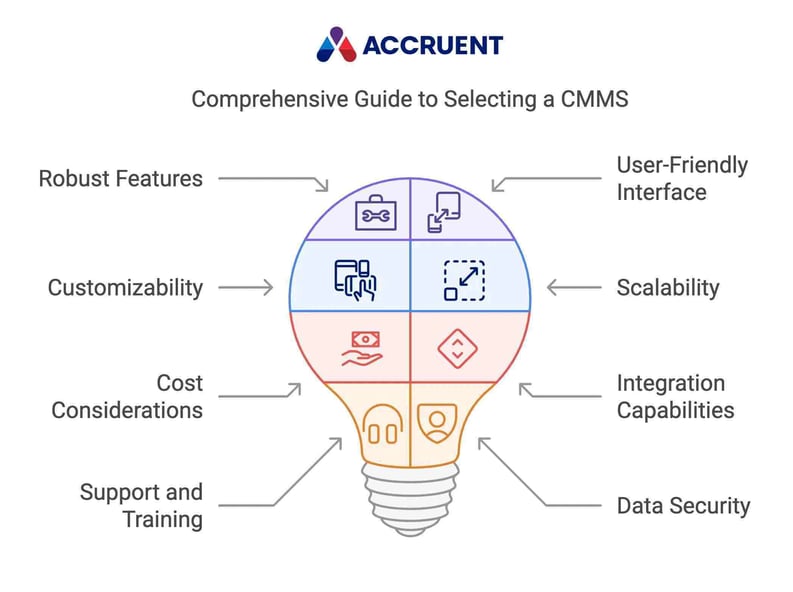
A comprehensive manufacturing CMMS should offer a range of features that address various maintenance needs, helping team members avoid potential issues or changes. Data and information are foundational for success in this department.
At its core, the software should be intuitive and easy to navigate. An intuitive design reduces the learning curve for new users, making training and onboarding much more efficient. Look for simple features like dashboards, drag-and-drop functionality, and clear, concise menus. Reducing friction here for users will avoid future headaches and help users easily transition to the platform.
CMMS software's customization allows it to adapt to specific manufacturing processes. Tailoring the software to meet requirements means it can perfectly align with a facility’s operations. For instance, if a manufacturing process involves specialized equipment or unique maintenance schedules, customizable CMMS software can accommodate these specificities. The result is more efficient and effective maintenance management. Further, the proper customization means it can integrate within current systems, avoiding any potential hiccups from adopting new technology.
As a business expands, its software should grow with it. The right manufacturing CMMS software should meet increased demands without performance issues, whether that’s data, users, or both.
For example, cloud-based solutions offer flexible storage and processing power that grow alongside a business's needs. Meanwhile, modular add-ons allow the expansion of functionalities without overhauling the entire system. These features provide a cost-effective approach to enhancing capabilities as operations scale up. The scalability feature means that the CMMS remains effective and reliable – regardless of how a business grows.
Budget drives business decisions and shouldn’t hinder them. Evaluating costs helps companies understand manufacturing CMMS software's short- and long-term value. Important considerations are as follows:
A manufacturing CMMS’s effectiveness depends on its integration with other enterprise systems. When integrated correctly, the software encourages smooth data flow and coordination across various business functions. For instance, combining a document management system, IoT, and connected devices can create a centralized platform for maintenance teams. This integration allows easy access to asset documentation and real-time monitoring and encourages better decision-making.
For example, Accruent Maintenance Connection helped SSAB address challenges such as tracking asset health, organizing equipment details, and minimizing machine downtime. The solution provided quick access to asset specifications, automated preventive maintenance schedules, and improved visibility into asset performance. As a result, SSAB successfully reduced downtime, enhanced operational efficiency, and achieved more effective asset management across its global operations.
It’s crucial to establish a robust support and training framework to maximize the value of manufacturing CMMS software. Addressing technical issues promptly through vendor support can help minimize disruptions and keep operations running smoothly. Providing comprehensive training resources, such as user guides, tutorials, and interactive sessions, ensures that teams can fully utilize the software’s capabilities. Ongoing support and continuous learning opportunities are essential for helping users adapt to updates, explore new features, and maintain productivity over time. By prioritizing these steps, organizations can fully unlock the potential of their CMMS system and drive greater efficiency.
Data is only as valuable as it is secure. Robust security measures, such as encryption, safeguard data against unauthorized access and breaches. Look for controls and permissions allowing authorized personnel to access specific features and information. Manufacturing CMMS software should provide regular data backup and recovery plans in case of issues. When in place, this ensures business continuity and data integrity.
Maintenance Connection is a trusted CMMS solution tailored to the unique demands of the manufacturing industry. Its advanced features and capabilities address critical maintenance challenges, empowering organizations to achieve operational excellence and meet performance goals.
Maintenance Connection offers flexibility and scalability that meet manufacturing’s complex needs, making it ideal for managing the intricate operations of manufacturing plants. Whether you're overseeing a single facility or a global network, the platform adapts to your needs, efficiently handling diverse asset types and maintenance strategies.
Plan your investment with our CMMS pricing guide and pricing calculator.
By integrating advanced features with an intuitive interface, Maintenance Connection empowers plant managers, production supervisors, and facility managers to reduce costs, improve productivity, and minimize downtime. Its robust capabilities allow organizations to:
Toshiba International Corporation implemented Accruent Maintenance Connection as a centralized maintenance system across its plants, with about 100 users relying on it regularly. Read the full Toshiba case study to see how the company now uses it as a single source of truth for work orders, asset history, labor hours, parts information and reporting, helping teams improve visibility, collaboration and the shift from corrective to preventive maintenance.
CAREL rolled out Maintenance Connection across 7 plants in 7 months, bringing more than 4,000 assets and 500+ maintenance plans into one standardized system. Read the full CAREL case study to learn how the implementation improved visibility across sites, helped standardize maintenance plans and created a foundation for better scheduling, lower maintenance costs and spare parts optimization across global operations.
To learn more about CMMS software for Manufacturing, request a demo or contact us today.
Share

Share
Discover the meaning and secrets to successful maintenance management. Explore strategies to cut maintenance costs and boost operational efficiency.
Learn how to develop a robust preventive maintenance program. Explore step-by-step guidelines and expert tips to streamline maintenance operations.
Optimize uptime, reduce repair costs, and extend asset life with construction equipment maintenance software built for efficiency and ROI at scale.